Every year, I meet inventors who spent thousands — sometimes their entire life savings — on heavily marketed “invention help” services that ultimately did little or nothing to move their product toward actual business success.
And honestly, it’s heartbreaking.
Now let me be very clear:
This article is NOT accusing any specific company of wrongdoing today.
Some companies in this industry may have changed their business practices over time. I don’t know.
But what I am saying is this:
Inventors need to be extremely careful when evaluating companies that aggressively market invention development, invention promotion, licensing, or “idea submission” services.
Because historically, this industry has produced some very serious problems for inventors.
And the public record reflects that.
Real Product Development Is Usually Not Glamorous
One of the biggest red flags?
When someone immediately tells you:
“Your idea is amazing!”
“This is the next big thing!”
“Companies are going to love this!”
A real product developer usually does NOT react that way.
Real developers tend to be:
- pragmatic,
- analytical,
- realistic,
- and cautious.
Not because they want to discourage you — but because bringing a product to market is genuinely difficult.
Even good ideas fail all the time.
Success depends on far more than:
- having a clever idea,
- filing a patent,
- or building a prototype.
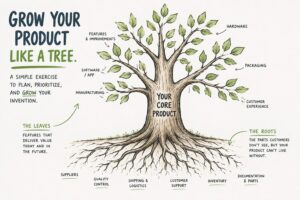
There are challenges involving:
- manufacturing,
- pricing,
- competition,
- marketing,
- logistics,
- retail acceptance,
- margins,
- timing,
- distribution,
- customer behavior,
- and execution.
Anyone trying to sell you expensive services while pretending those realities don’t exist should make you nervous.
There Is No “One Size Fits All” Invention Package
Another major warning sign:
A company offering every inventor essentially the same package.
Real product development does not work that way.
Every invention is different.
A medical device has different needs than a kitchen gadget.
A consumer product has different needs than industrial equipment.
A licensing strategy is different than launching your own brand.
That means the development path should also be different.
If someone is offering:
- the same roadmap,
- the same package,
- the same pricing structure,
- and the same sequence of services…
…for wildly different inventions?
That’s a problem.
Usually one of three things is true:
- The package is overpriced,
- It doesn’t include the services you actually need,
- Or both.
“But They Delivered What Was In The Contract…”
This part is important.
Many inventors later discover that these companies technically delivered what was promised in the agreement.
Maybe they:
- created renderings,
- made a prototype,
- filed a provisional patent,
- built a website,
- or mailed marketing packets somewhere.
The issue is often NOT:
“Did they technically perform the contract?”
The issue is:
“Did the services meaningfully advance the invention toward business success?”
And very often, the answer is no.
That distinction matters.
Because many inventors assume:
“If I pay enough money, I’m buying a path to success.”
But in reality, they may simply be buying services that sound impressive without actually solving the core business problems.
Ask Yourself: How Many Clients Do They Have?
Here’s another question inventors rarely ask:
How many clients is this company working with right now?
Are you:
- 1 of 5?
- 1 of 20?
- 1 of 500?
- 1 of several thousand?
And how does that affect:
- the time your project receives,
- the quality of attention,
- and the level of strategic thinking being applied?
Some invention promotion companies operate at enormous scale.
That business model alone should make inventors stop and think carefully about how individualized the guidance truly is.
Hard Truth: Your Idea Probably Isn’t “The Greatest Ever”
Inventors, let me say something difficult but important:
Your idea is probably not the greatest invention ever created.
Even if it’s genuinely good.
Even if it solves a real problem.
Even if people like it.
That’s still only ONE piece of the puzzle.
Any company that treats every inventor like they’re sitting on the next billion-dollar product may not be trying to help you think clearly.
They may simply be trying to close a sale.
A good development partner should sometimes tell you:
- when something is risky,
- when something may not be commercially viable,
- when the economics don’t work,
- or when you should slow down before spending more money.
That honesty is valuable.
Some Public Cases Inventors Should Research
Historically, there have been multiple FTC actions, settlements, lawsuits, and consumer complaints involving portions of the invention promotion industry.
Again:
This article is NOT making claims about any company’s current operations or practices.
But inventors absolutely should educate themselves and review public information before spending large amounts of money.
Some publicly available resources include:
- Federal Trade Commission case involving Davison & Associates / Davison Design & Development
- USPTO complaint publication system for invention promoters
- Information regarding “Project Mousetrap,” an FTC initiative focused on invention promotion practices
- FTC action involving World Patent Marketing
Inventors should also understand that under the American Inventors Protection Act, invention promoters are required to disclose certain statistics regarding:
- evaluated inventions,
- licensing outcomes,
- and financial success rates.
Those numbers can be extremely revealing.
Do Your Own Research
Before hiring anyone:
- research court cases,
- search for complaints,
- read contracts carefully,
- ask difficult questions,
- and seek independent opinions.
Don’t rely solely on:
- testimonials,
- flashy websites,
- success stories,
- emotional sales pitches,
- or television commercials.
A legitimate product development journey is usually:
- slower,
- more uncertain,
- and more nuanced…
…than the advertisements make it sound.
Final Thought
There ARE legitimate companies and professionals in the invention and product development world.
But inventors need to understand something critical:
A company making money FROM inventors is not necessarily the same thing as a company making money WITH inventors.
That distinction matters.
A good development partner should be focused on helping you make smart business decisions — even when that means telling you things you may not want to hear.
Because real product development is not about selling dreams.
It’s about navigating reality.