One of the biggest mistakes I see is inventors thinking of their invention as a finished object.
“I’m designing a better cooler.”
“I’m building a new kitchen gadget.”
“I just need a prototype.”
But if your goal is to profit from an invention, you have to think beyond the prototype.
You’re not simply building a product.
You’re growing a business around an invention.
Like a tree, successful products don’t appear overnight. They start with strong roots, grow deliberately, shed what isn’t working, and mature over time.
This simple exercise can help you develop an invention more strategically, avoid feature overload, and improve your odds of becoming a successful inventor.
Draw Your Product Tree
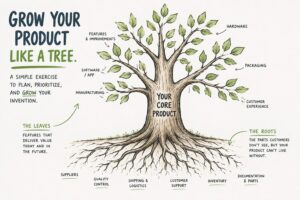
If you’re wondering how to develop an invention, grab a large sheet of paper and draw a tree.
Seriously.
Don’t worry if your artistic ability stopped improving in fifth grade. This isn’t about creating artwork—it’s about organizing your thinking.
The Trunk: Your Core Invention
The trunk represents your invention’s primary purpose.
If someone asked,
“What did you invent?”
your answer belongs here.
Everything else grows from that central idea.
The Branches: Major Parts of Your Product
Each major branch represents one major aspect of bringing your invention to market.
Examples might include:
- Core functionality
- Electronics
- Software
- Manufacturing
- Packaging
- Customer experience
Your branches will depend on your invention, but every successful product has major systems that need attention.
The Leaves: Individual Features
Every feature becomes its own leaf.
Write each one on a sticky note so you can move it around.
Features closest to the trunk belong in Version 1.
Leaves farther out represent future improvements.
This simple visualization helps you see not only today’s product but how your invention can evolve over time.
Don’t Forget the Roots
Here’s where many inventors unintentionally get into trouble.
The roots represent everything customers rarely notice—but your business depends on.
Think about:
- Manufacturing
- Suppliers
- Quality control
- Shipping
- Inventory
- Documentation
- Replacement parts
- Customer support
Many inventors focus exclusively on how to prototype an invention, but the prototype is only one branch of the tree.
Without healthy roots, even the best invention struggles to survive.
Prune Before You Prototype
One of the hardest lessons in product development is learning what not to build.
Ask yourself about every feature:
“If I removed this, would my customer actually care?”
Every additional feature increases:
- Development cost
- Prototype cost
- Manufacturing complexity
- Testing time
- Customer support
- Risk
Ironically, one of the fastest ways to develop an invention successfully is by removing unnecessary complexity before you build the first prototype.
Sometimes pruning creates a better product than adding another feature.
Is Your Tree Balanced?
Now step back.
Does one branch dominate the others?
Have you spent months refining one clever feature while barely considering manufacturing or customer support?
A lopsided tree often reveals a lopsided product strategy.
The picture usually tells you what your project spreadsheet doesn’t.
Ask Other People to Shape Your Tree
If you’re serious about succeeding as an inventor, don’t build your tree alone.
Invite potential customers, mentors, or trusted advisors to add and remove leaves.
Ask them:
- What’s missing?
- What would you remove?
- What would make this more valuable?
- What seems unnecessary?
Then listen.
Don’t explain.
Don’t defend.
Just learn.
Fresh eyes often spot opportunities you’ve been too close to see.
Think in Seasons, Not Versions
This may be my favorite part of the exercise.
Products have seasons.
A sapling isn’t supposed to provide shade.
It’s supposed to grow strong roots.
Too many inventors try to build the giant oak on day one.
They want every feature.
Every accessory.
Every customer.
Every future idea.
That’s like expecting a sapling to support a treehouse.
It can’t.
And it shouldn’t.
If you want to profit from an invention, focus first on building a healthy trunk and a few strong branches. Once customers prove they value your product, you can continue growing it season after season.
That’s how successful products mature.
Final Thoughts
The healthiest trees aren’t the ones with the most branches.
They’re the ones with strong roots, balanced growth, and the wisdom to let go of what doesn’t belong.
The same is true for inventions.
If you’re wondering how to develop an invention, don’t start by asking:
“What feature should I add next?”
Instead ask:
“What kind of tree am I trying to grow?”
You may discover that the path to succeeding as an inventor isn’t about building more.
It’s about growing smarter.